Anaesthesia is the drug-induced reversible loss of consciousness, absence of pain, immobility or relaxation of muscles.
The uses for this technique range from a simple local anaesthetic, to numb a small part of the body, to the induction of complete unconsciousness to allow diagnostic or surgical procedures to be performed.
We have a team of Specialist Anaesthetists supported by Residents, Interns, technicians and highly qualified nurses. Our priority is to ensure the maximum level of patient safety and comfort.
Anaesthesia in a pet is very similar to that in people. Depending on the procedure to be undertaken, local, regional or general anaesthetic techniques may be used.
General anaesthesia using modern drugs and techniques, combined with a high degree of expertise, means that risks are minimised as much as possible and adverse situations are rare.
All patients undergo a physical examination to check for conditions that may require particular attention during the procedure, and further investigations are performed if indicated. We administer pre-anaesthetic medication to calm the patient, provide some pain relief and allow placement of a cannula for drug and fluid administration. When the patient is taken to the theatre preparation area, we assess the impact of pre-anaesthetic medication on heart and lung function before giving the anaesthetic drug(s). Throughout the period of anaesthesia, a range of parameters including heart rate, blood pressure, breathing and oxygen levels are monitored closely. Animals recovering from anaesthesia will be cared for by our dedicated team of ward nurses and those undergoing major procedures will be nursed in the dedicated intensive care ward.
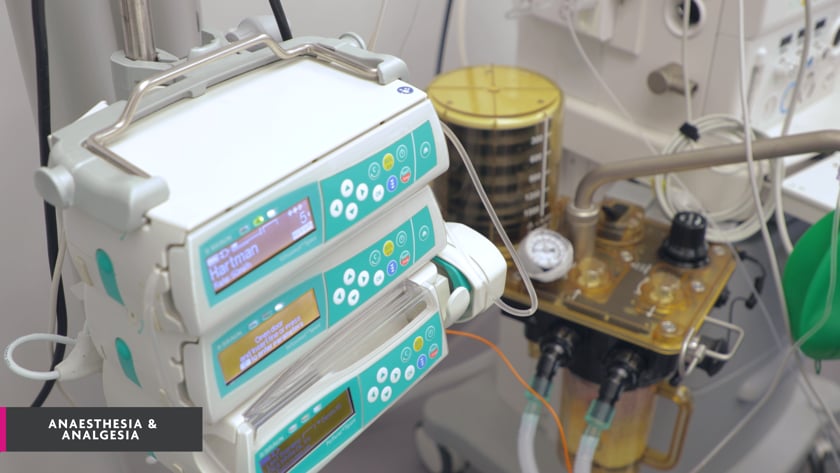
We use highly sophisticated anaesthetic machines and monitoring equipment and this, combined with modern anaesthetic techniques implemented by expert staff, is the key to minimising pain and stress for the animals in our care.
Please remember that your consultant will be happy to answer any further questions you may have.
Sedation is provided by the administration of sedative drugs that can make your pet calm and compliant, whereas general anaesthesia is a state of controlled unconsciousness obtained with the administration of anaesthetic agents. General anaesthesia is usually induced with the intravenous injection of an induction agent and, once the trachea (windpipe) is intubated, maintained with a mixture of anaesthetic gas and oxygen.
Nearly all of our surgical procedures are performed under general anaesthesia, as well as most of our advanced imaging procedures. In some cases, the procedure would be suitable for a pet to be sedated, but there might be considerations regarding your pet that make it safer for them to be anaesthetised. For example, some heart conditions can make pets unsuitable to receive some sedative drugs and in this case, anaesthesia would have fewer side effects, whilst allowing the procedure to take place. Another example would be if your pet is regurgitating or vomiting, where deep sedation may allow aspiration (inhaling) of the stomach contents leading to pneumonia; general anaesthesia would protect better against this.
Your pet may need investigatons requiring sedation or general anaesthesia. Sometimes these can be scheduled on the same day as your appointment.
It is common to withhold food for some period of time prior to sedation or general anesthesia in dogs and cats, as well as in humans. This helps prevent regurgitation and gastro-oesophageal reflux (movement of stomach content into the mouth or oesophagus, respectively) during the procedure. Regurgitation and reflux can lead to serious complications such as inflammation of the oesophagus and inhalation of the stomach contents affecting the lungs and breathing.
Traditionally, long fasting times (more than 10 hours) have been recommended for healthy adult dogs and cats. However, current evidence suggests that longer fasting periods have a greater risk of gastro-oesophageal reflux with no differences in regurgitation risk. Thus, current recommendations for healthy adults establish a fasting period of 4 to 6 hours. Ideally, the meal should be a wet (canned) diet or a light meal (half of the normal requirements). Water should be freely available all the time. For small pets under 2 kg or young pets, up to 16 weeks, withholding of food should not be longer than 2 hours.
Therefore:
- In adult pets, a last meal can be fed late at night before the morning of the appointment.
- In small (less than 2 kg) or young pets (less than 16 weeks old), please check with your vet or contact DWR Vet Specialists via the general enquiries advice form on the website or by calling our reception (01638 572012), whether a light meal should be fed in the morning.
- If your pet is diabetic, please feed and give insulin as usual on the morning of your first visit.
However, it is important to note that the recommended fasting time can vary depending on overall health of your cat or dog and fasting might not be recommended with some medical conditions. For this reason, it is essential to always consult with a veterinarian for individualised fasting guidance to ensure the safety and well-being of your pet throughout the procedure.
Reference:
- AAHA guidelines; Savvas et al (2022) Factors affecting intra-op GOR in dogs + cats. Animals 12, 247.
Sometimes your pet will require some investigations which involve sedation or general anaesthesia the same day as your appointment. Some medications should be continued, while others may need to be modified or discontinued to optimise patient management through anaesthesia.
Medications that should be continued on the day of anaesthesia include those for chronic conditions such as heart disease and endocrine diseases. Anticonvulsant (anti-seizure) medications should also be continued to prevent seizures triggered by the stress of surgery. Medications for chronic pain should be continued to manage pain, and antibiotics should be continued until the prescribed course is completed to prevent infection.
Some medications may need to be modified. For animals with Addison's disease or hypoadrenocorticism, corticosteroid medication should be continued, but the dosage or timing may be adjusted to manage cortisol levels during the anaesthesia and recovery period. Sedatives and tranquillizers may also be modified to reduce stress while in the hospital, but their administration should be closely monitored as they can interact with anaesthetic agents.
Certain medications should be avoided, such as nonsteroidal anti-inflammatory drugs (NSAIDs) and anticoagulants. NSAIDs can cause gastrointestinal, renal, hepatic and coagulation complications, which can affect the animal's ability to tolerate anaesthesia especially when combined with low blood pressure – a common problem encountered with general anaesthesia. Anti-hypertensives (such as amlodipine) and Angiotensin-converting enzyme (ACE) inhibitors (benazepril, enalapril) should not be given on the day of surgery as these can make treating low blood pressure under anaesthesia tricky. Anticoagulants should be avoided as they can increase the risk of bleeding during surgery.
In summary, it is essential to review the animal's current medications before anaesthesia with a veterinarian. Medications that should be continued, modified, or avoided will vary depending on the animal's specific medical needs.
If you have any concerns or questions about medication management for your pet's upcoming anaesthesia, please contact a member of our veterinary team or enquire via the general enquiries advice form on the website. We will be able to provide you with individualized advice based on your pet's medical history and the type of procedure they will be undergoing.
Reference:
- Grubb T et al (2020) 2020 AAHA anaesthesia and monitoring guidelines for dogs and cats. J Am Anim Hosp Assoc, 56.
We understand that each pet has their own personality. We want to make their visit as free of stress as possible and safe for them and for you, as well as for us. Our clinical staff have a lot of experience with these behaviours.
Please tell us if your pet can be anxious or aggressive. In many cases, there are medications that can be given orally at home before their visit, which can help these behaviours. In some cases, medications would not be appropriate.
If you would like more information about this for your pet’s upcoming visit, please contact us either by calling our reception (01638 572012), or by using the general enquiries advice form on our website.
Ageing changes are gradual, progressive, and generally irreversible. They confer reduced organ capacity and function. Lifespans of our pet cats and dogs vary, but an individual is termed geriatric when it has completed 75–80% of its expected natural lifespan. Therefore we consider medium-sized dogs older than 8 years, small dogs older than 12 years; giant breeds older than 6 years, and cats older than 11 years to be elderly.
Research has shown that risk of mortality associated with general anaesthesia does increase with older age: cats and dogs 12 years or older were twice or seven times more likely, respectively, to suffer anaesthetic related death compared to young adults of the same species.
It is important to determine any existing organ dysfunction and stabilise your pet before general anaesthesia to optimise anaesthetic management. Pre-anaesthetic blood testing is often advised in elderly dogs and cats, even if, after considering their medical history and on physical examination, they appear healthy.
Elderly pets are more likely to have concurrent underlying disease, such as problems with liver or kidney function that can affect how anaesthetic drugs are handled by the body and which general anaesthesia can worsen, so extra monitoring might be indicated in these cases. It is also common for them to have endocrine disorders such as hypo- or hyperthyroidism, or diabetes mellitus. It is important to assess the heart and lungs as they can have degenerative heart changes (endocardiosis, valvular insufficiencies, cardiomyopathies, etc.) that can predispose to arrhythmias. Decreased lung or breathing function can increase risk of low oxygen in the immediate pre and post anaesthesia periods.
Older pets suffer more ‘emergence delirium’ as they recover from anaesthesia than other patients, possibly due to senile and brain changes and increased anxiety. Therefore this is monitored closely and treated if needed during your pet’s stay with us.
References:
- Brodbelt DC et al. (2007) Risk factors for anaesthetic related death in cats: results from the confidential enquiry into peripoperative small animal fatalities (CEPSAF). Br J Anaesth, 99: 617-23.
- Brodbelt DC et al. (2008) Results of the Confidential Enquiry into Perioperative Small Animal Fatalities regarding risk factors for anesthetic-related death in dogs. J Am Vet Med Assoc, 233:1096–1104.
Puppies and kittens are considered neonatal in their first 4 weeks of life and paediatric until 12 weeks of age. Their bodies and organ systems are immature. At around 12 weeks old, puppies and kittens are, physiologically, mature.
Anaesthetising very young patients is slightly more challenging than their adult counterparts (LINK to GA risk page. Because of their small size and immaturity, very young puppies and kittens can become quite cold quickly when sedated or anaesthetised. This increases the amount of oxygen they need when they are recovering because of shivering, and also has effects on other body systems such as the heart. Furthermore, very small patients are often a logistical challenge if our usual equipment is too big for them.
Due to their reduced ability to produce sugars in the liver, fasting before sedation or general anaesthesia should only be performed with advice from a vet. The duration should be reduced to 2-4 hours (dependent on your pet’s exact age) to prevent a dramatic drop in sugar levels in the blood that can be fatal if not recognised and treated. Neonatal pets should be kept with their mother for as long as possible.
The heart and vessels are immature, so heart rate and blood pressure are monitored closely under anaesthesia, as with older patients, and medication given to support them as needed. The weaker breathing muscles and immature airways can cause impairment of breathing, so we usually take over their breathing for them when they are anaesthetised to ensure they receive enough oxygen.
Young animals show a decreased drug metabolism that can lead to prolonged recoveries from anaesthesia or sedation. This is always taken into account with very young pets and we employ careful drug selection with doses adjusted as required.
After recovery, your young pet will be kept warm and comfortable and they will be fed as soon as possible once they can swallow and cough. Neonatal animals should return to their mothers as soon as possible.
Brachycephalic breeds include cats and dogs with a flatter or shortened face (for example: pug; French, English and American bulldog; Boston terrier; Boxer; Dogue de Bordeaux; Persian cat).
These breeds have a skull of usual width but shortened length. Their nostrils and trachea (windpipe) are often narrowed and they can have a long, thick soft palate. This anatomy means there can be marked effort associated with breathing, which can worsen with exercise, heat, and stress or excitement. Sometimes the entrance to the windpipe in the throat can become swollen as a result and lead to further deterioration of breathing, or occlusion of the airway. This increased breathing effort also alters the pressure within the abdomen and can cause regurgitation (stomach contents moving up into the mouth). This can cause inflammation of the oesophagus and, if inhaled from the mouth, pneumonia. Such a scenario is commonly described as brachycephalic obstructive airway syndrome (BOAS).
Your pet might require anaesthesia for surgery for BOAS, or for a separate condition. In both cases, as well as the usual risks of general anaesthesia, the following are of additional concern.
Airway obstruction – brachycephalic patients are at risk of this when they are awake and conscious as described above. This is also a concern at the beginning and end of anaesthesia when we take the breathing tube out of their windpipe and their airway can become blocked. We always have multiple pieces of equipment to hand, should this problem develop around anaesthesia. Whilst hospitalised, we may give sedation to your pet if they are getting very anxious and stressed. We are also careful on hot summer days with walking times to avoid heat exacerbating their condition.
Overheating – because of their altered breathing pattern, they do not lose heat well and can have a high body temperature, which can exacerbate airway swelling. Therefore, we keep them cool and are careful on hot summer days with walking times to avoid heat exposure.
Regurgitation – this can occur in any patient under sedation and anaesthesia; however, your pet will be at a higher risk for this to occur. If your pet is regurgitating, it is unlikely they would be sedated for a procedure where sedation would suffice. When a patient is sedated, they become calm and relaxed, but we cannot protect their lungs by putting a tube into their windpipe like we do with anaesthetised pets (the tube delivers the anaesthetic gas and oxygen, and protects the airway and lungs from anything in the mouth). Therefore, it is likely they would require general anaesthesia.
Before, during and after your pet’s procedure, a dedicated anaesthetist will look after them, and work with the other teams to care for your pet.
Anaesthesia is not contraindicated in stable, otherwise healthy diabetic dogs and cats. In fact, anaesthesia is necessary as part of the treatment of different conditions that promote insulin resistance like dioestrus in female dogs, or dental disease. It is also needed for treating secondary diabetic complications such as cataracts or non-healing wounds.
Before anaesthesia, blood and urine testing is usually advised, because it will help the anaesthetist to understand if your pet is stable for general anaesthesia or not. If they are not stable, especially in ketoacidotic patients, they will need to be stabilized before undergoing a general anaesthetic.
The goal during the period of the general anaesthesia and the hospitalisation period is to provide minimal disruption to your pet’s diet and insulin routine. To facilitate this, it is advised your pet stays in the hospital the night before the procedure to start intravenous fluid therapy (a drip) to prevent or treat any glucose, electrolyte or fluid inbalance, which diabetic patients can have. It is also advisable for owners to bring their pet’s food and a description of their usual routine including timing and amount of food, insulin and exercise to help minimise disruption.
Your pet’s procedure will be scheduled in the morning. On the day of the procedure, your pet will be fasted, as it helps prevent reflux of stomach contents under anaesthesia. Insulin will be given at the usual time after checking blood glucose level, which will determine the amount of insulin given at that time – your pet will not have eaten breakfast, so their blood glucose measurement might be lower than usual.
During the general anaesthetic, the glucose values will be checked every 30-60 minutes by the anaesthetist to recognise and treat too low or too high blood glucose. Diabetic patients are also more likely to have low blood pressure under general anaesthesia. We will measure their blood pressure regularly and treat this if it becomes a concern. Afterwards, your pet will be encouraged to eat as soon as possible once they are awake after recovery to help get them back to their usual feeding and insulin treatment times.
Reference:
- Oliver J et al (2010) A comparison of complications between diabetic and non-diabetic dogs undergoing phaecoemulsification cataract surgery: a retrospective study. Vet Ophthal 13, 244.
Locoregional anaesthesia is a pain relief technique that delivers pain-relief to targeted regions of the body. This differs from systemic analgesia, which is delivered through the bloodstream. One significant advantage of locoregional anaesthesia is that it blocks the pain signals before they reach the brain, providing better pain control and reducing the need for rescue analgesia and its associated side effects.
Moreover, locoregional anaesthesia helps to reduce the stress response to surgery. By blocking the pain signal transmission to the brain, locoregional anaesthesia can decrease the negative effects of the stress response on the body, such as impaired wound healing and increased risk of infection.
Examples of locoregional anaesthesia techniques include epidural anaesthesia and peripheral nerve blocks. Epidural anaesthesia is administered by injecting anaesthetic agents into the epidural space surrounding the spinal cord, providing pain relief during abdominal, thoracic, and hind limb procedures. Peripheral nerve blocks involve injecting anaesthetic agents around specific nerves, providing pain relief to a particular area of the body.
As with any medical procedure, there are risks associated with locoregional anaesthesia, including the potential for infection and nerve damage, and the risk of systemic toxicity if the drugs are injected into the bloodstream. Structures, such as other organs, can be damaged if the needle is placed incorrectly. Nevertheless, new techniques have been developed, which have been implemented in our hospital, to reduce the incidence of these side effects.
In summary, locoregional anaesthesia is a targeted pain relief method. Although there are risks associated with these procedures, they can be reduced with use of proper technique and training
Reference:
- Romano M et al (2016) Stress-related biomarkers in dogs administered regional anaesthesia or fentanyl for analgesia during stifle surgery. Vet Anaesth Analg, 43, 44)
An epidural catheter is a long thin flexible tube inserted into the epidural space around the spine, allowing the delivery of medication directly to the nerves that transmit pain signals. This is placed under general anaesthesia, but remains in place afterwards. You might be familiar with epidural catheters from a human childbirth scenario. We use epidural catheters regularly, to provide local analgesia for pets undergoing some surgical procedures for pain management afterwards. Occasionally we might use them pre-operatively.
The benefits of using an epidural catheter in our patients include:
- Effective pain management – as the pain medication is delivered directly to the nerves that transmit the pain signals allowing for precise regional delivery of pain medication. We can give repeated doses of medication and also adjust the next doses if more or less pain relief is required.
- Reduced risk of side effects – because the medication is delivered directly to the nerves, lower doses of intravenous medications that affect the whole body are required. This reduces possible side effects like vomiting, nausea, and sedation. In many cases, other additional pain relief is not needed.
- Quicker recovery – by providing effective pain relief, epidural catheters can help our patients return to their normal activities sooner.
Similar to any procedure, the placement and use of an epidural catheter in dogs and cats, as in humans, is not without potential complications, such as:
- Dislodgement – movement can cause the catheter to “back-out” of the space and it becomes unuseable. This is the most common complication, though still infrequent at 16% of cases in one study.
- Infection – a risk present with any invasive procedure and indwelling catheter.
- Nerve damage – improper placement of the catheter can result in nerve damage, leading to pain or neurological complications.
- Bleeding – insertion of the catheter can cause bleeding in rare cases, which could lead to spinal cord compression. An epidural catheter would not be placed in patients with known or suspected clotting problems.
- Catheter misplacement, breakage and retention – these are rare complications which can occur even with experienced and skilled practitioners, with misplacement reported in 3% of cases in one study.
It is important to note that these risks are uncommonly reported, with serious complications even more rare. We minimise the risk by following proper insertion and removal techniques and monitoring our patients closely for any signs of discomfort or complications.
Overall the use of an epidural catheter in animals can be a highly effective way to manage pain and improve the recovery process after your pet’s surgery.
References:
- Hansen B (2001) Epidural catheter analgesia in dogs and cats: technique and review of 182 cases (1991-1999) J Vet Emerger Crit Care 11, 95-103;
- Swalander et al (2000) Complications associated with the use of indwelling epidural catheters in dogs: 81 cases (1996-1999). J Am Vet Med Assoc 216, 368.
Team Members
Valentina Campoli